The Glass House
For Ford Employees
Yesterday, Today and Tomorrow
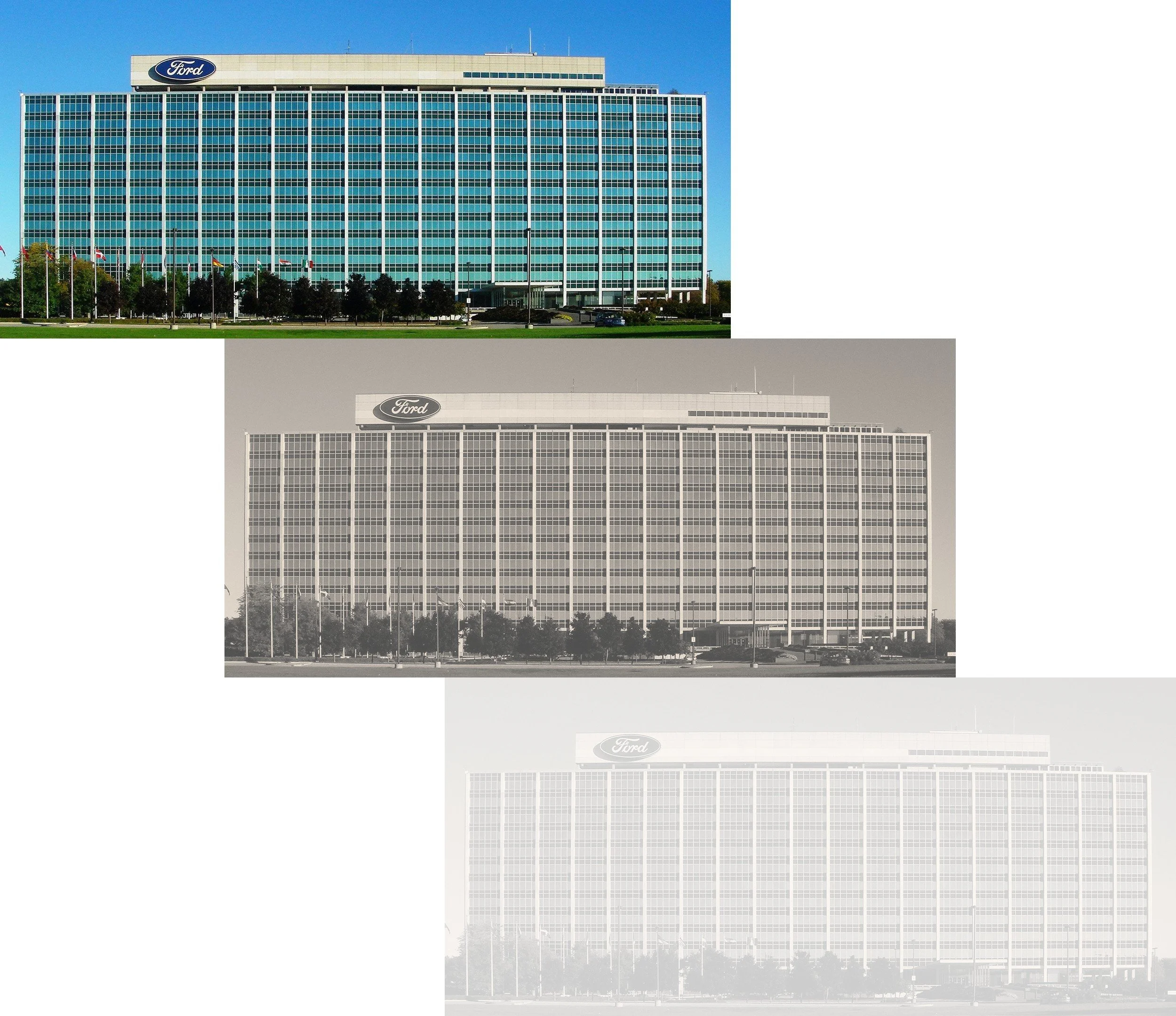
When it was built, seventy years ago, it was a testament to the imagination of architects, to the bold reality that could be wrested from raw materials – steel, stone and glass.
In those early days it rose, a monolith reflecting the sun and shading the former farmland from which it seemed to erupt. It was visible for miles. It dominated the Ford property, the Fairlane estate hidden from view in the trees along the Rouge River a half mile west; and the brooding and mighty Rouge complex, a vast jumble of dark buildings which even today symbolize raw power and might, hunching a mile southeast.
It dominated Dearborn.
Today, some seventy years after its dedication in 1956, Ford World Headquarters, or WHQ, swings into view as you travel up the ramp from eastbound I-96 onto the M39 Southfield Freeway. It is some four miles away. You will travel south down M39 through Detroit and into Dearborn; the building will appear and disappear as you do.
As you enter Dearborn, crossing under Ford Road, World Headquarters rises tall. Heading towards US12, Michigan Avenue, you will pass it on your left, and you may wonder as its broad front morphs into a narrow profile. Sighted along its west-to-east axis, it is remarkably slim.
It is twelve stories tall – thirteen, if you count the exclusive Penthouse perched on top, next to the giant blue ovals, trademarks known around the world, simple white script on a blue background, a shield pointing to far earlier times. Twenty silver columns grace its front and rear. Underneath the building, its basement houses various service functions.
You have four approaches to World Headquarters. First, and most impressive, is from the south. If you’re a visitor, this is how you enter. You survey the circular drive that arcs up to the building, blocked by stone barricades installed after 9/11. Flags from countries around the world march along the oval drive toward the building.
You park in the visitor parking lot in front, and you ascend the wide brick promenade, the building towering over you and stretching from side to side. You enter through the front doors and present your credentials to the security guards. If allowed to proceed, you either use your badge at the waist-high glass gates or wait for the guard to open a gate to let you in (1). You pass a small showroom of the latest Ford models as you head inside.
The second way is through the back, from the north. If you're an employee, this is how you enter. You park in the massive parking lot that stretches far and wide north of the building, and you walk to the rear entrance. In winter, you are thankful when you reach the glass-shielded entrance ramp, where you are sheltered from cold winds sweeping that vast acreage. You are presented with several identical doors. Selecting one, you enter and badge your way in. You are faced with an immense hallway, some thirty feet wide and hundreds of feet long, that takes you past the security office, the store, the cafeteria, and the auditorium on your left and (unbeknownst to you, unless you are a manager) past the executive garage hidden on your right (2). You reach the slender core of the building and either use the elevators or the escalators that rumble through the guts of the building from floor one through floor eight, to go to your office.
A third way, for managers — through the west side, from a small parking lot. I had forgotten about this one, until a colleague reminded me.
The fourth way is even less well known. To enter this way, you must first enter the Ford Credit Building (FMCC), a large, flat, partially sunken structure some thousand feet northeast. You must pass security to enter FMCC. Once inside FMCC, you head to the lower of the two floors and make your way to the tunnel that connects FMCC to WHQ. Security cameras monitor this tunnel as you take the long walk from FMCC to the basement of WHQ. From that basement you will usually take stairs (though there is a freight elevator). You open the door at the top of the stairs, popping up like an industrial mole, and you join the stream of people moving about in the main hallway.
This is the Ford World Headquarters. WHQ.
This is the monolith, the blue-badged behemoth that is the defining building of the Dearborn landscape. This is the Glass House, the award-winning testament to architecture, from the top floors of which you could look southwest to the Ford Research and Development Center, the Dearborn Proving Grounds, where vehicles are conceived, designed, engineered, and tested. Or you could look southeast, to the dark jumble, the irregular and angular shapes of the Rouge Complex, one of the largest industrial ecosystems in the world, home to casting furnace and steel mill, railroad track and assembly line – the beating heart of manufacturing, where the legendary F-150, America's truck by some standards, was and still is assembled, and where in the past if you worked the Rouge long enough, your car suffered from pitting caused by industrial fallout; where, too, brutal fights broke out as Labor, headed by Walter Reuther, Richard Frankensteen, and others, were beaten by Ford's security forces in the Battle of the Overpass. This in 1937. South Dearborn and Melvindale surround the Rouge – a gritty, pockmarked landscape abuzz with trucks and other industrial buildings. And under all, the Detroit salt mines, one hundred miles of tunnels mostly unknown to people who haven't grown up here.
Or you could look farther still, to see the graceful lines of the Ambassador Bridge, one of the most crucial trade arteries on the continent, over which vehicle parts and assemblies travel multiple times between the United States and Canada, in a complex, international dance giving birth to vehicle after vehicle. To the east, you could look downtown, past the dark bulk of the once proud, then ruined, now proud again Michigan Central building, to the Renaissance Center, symbol of a Detroit struggling to shed not only its violent 1967 race-riot past, but also to shed the stigma that here was a city on the ropes, bereft of vision, losing convincingly to the Japanese in the 1970's and 1980's, only to return to life re-energized (3).
Immediately east, you could survey the East Dearborn neighborhoods, where over the years so many people of Middle Eastern origin established new roots – whether escaping the Lebanese Civil War, or other diasporic responses – thus creating the largest enclave of Middle Eastern people in the country. Down those streets you can get some of the best Middle Eastern food around, if you know where to look.
Until its next-door neighbor, the former Hyatt Regency (4), rose on the other side of the Southfield Freeway, the only challenge to the Glass House view was from the Parklane Towers to the northeast. Another building, Regent Court, was built after all of these and has already been torn down. Some things truly don't last.
When first built, though, World Headquarters ruled these fields. To Henry Ford II, grandson of the founder, inheriting a company that barely found its way back from the role it played as America's World War II Arsenal of Democracy, the new building represented the apex of aspiration, testament to the power and reach of the American automobile industry. The view from its top floors allowed him – and anyone working there – to survey the extent of the Ford Dearborn empire.
World Headquarters. The Henry Ford II World Center. The Glass House. WHQ. It is the building that defines the Dearborn landscape, representing the company that in so many ways defines Dearborn.
Or was.
Now that we are in the 21st century; now that once again electric vehicles are overtaking internal combustion offerings (or perhaps not); now that vehicles are computers on wheels whose main purpose seems to be monetizing conveniences and coaxing you to part with your pennies through subscriptions; now that the Ford Motor Company is one among so many competitors in a world beset by challenges, conflicts, climate change, social media, AI, polarization and all the rest – now is the time for a new beginning.
Some call this time late-stage capitalism. For one who's lived through WHQ's entire life, from 1956 when I was born and it was dedicated, until today, some seventy years later, this does seem to be a new world – and yet, somehow, older than the one in which I was raised. Still, in this new century, the new supplants the old; and the old, impressive and imposing as it has been, must yield. That's what the young would say. The old become less sure, not only of themselves (as physical things frail, the spine bends, and the brain struggles to decide what to retain and what to learn anew); but also less sure that old or new are ever superior, one to the other, simply because of their oldness or newness. That's for another time to decide.
So Ford World Headquarters has moved, once again, this time a mile or so to the west-southwest. The triumph of glass and steel that was the Glass House has yielded to a new declaration of glass and steel which, while four stories tall, is so capacious that multiples of Glass House employees can fit inside.
What is new, what glitters, is what attracts. WHQ's younger sibling beckons from the southwest. Michigan Central, into which much Ford treasure has been poured, gleams from the southeast. And this old glass house, astride M39 and US12, is now empty, with only echoes of voices remaining. There were leadership discussions here, many of them. And ordinary, everyday work as well. It housed both the dramatic and the mundane, the aspirations and frustrations, ambitions and objectives, of the thousands who worked here over seven decades.
But its time is over. It is not Michigan Central, with the promise of new things. It is not where product is designed or built. It is legacy. There is no treasure – and no will – sufficient to save it.
This old, idle place – WHQ to so many of us – will be torn down.
The new World Headquarters rises within Ford's Research and Development campus. It is a long stone's throw from the great indoor and outdoor museums called The Henry Ford but which many locals still refer to as the Henry Ford Museum and Greenfield Village. It shares space with a complex of buildings that include design and engineering activities and test facilities and that, unless things have changed, are also linked by tunnels – although I would find it surprising to find that the new WHQ sports as many subterranean avenues. After all, those were built in times of war, times in which casualties were counted in hundreds of thousands.
The new WHQ is not far from the original Research and Development buildings – among them the Dynamometer Building, where I began my Ford career in 1978. The Dyno Lab does what its name suggests – uses massive machines called dynamometers to test engines before those engines are deployed in tens of thousands of vehicles. Dyno has something few buildings can attest to: walls so thick that World War II bombs could not penetrate them. Those were the times. We once feared conventional bombs. Today, our monsters are much more subtle, stealthy and pervasive. Our strong buildings and isolated geography prove to be no match for the insidious weapons of mass disinformation and cyber attacks that threaten to paralyze us.
The new WHQ rises four stories. What can it oversee? Does its vision match that of its older, abandoned sibling? What views will people have from its windows? What new stories will it tell?
These will be the stories of a different time. A time in which technology accelerates, human boundaries erode, while artificial intelligence appears to collapse the future in upon itself, a recursively accelerating redefinition of work, whether human- or machine-centric. All this in a time when we not only assert our bold moves into the future, but we also yearn for the constancy of the past, the time before today's sharp-edged, media-encouraged stories seek to divide us. That's to be expected. Throughout its long life, the Glass House saw many sharp-edged divisions, too.
All of us who grew up with the Glass House know what's been lost. We feel it in our bones. It may be harder for us to unlearn the technologies of the past, the better to embrace the promises – and perils – of the future. Constancy of purpose and content of character, each rare and precious, remain the solid guides.
Younger people will never know what it meant to enter the Glass House for the first time as an employee. This isn't something new: even fewer people remember what it was like to experience Mahogany Row, as I did: the dark-paneled offices of the Central Administration Building, older sibling to the Glass House, where Henry Ford once surveyed the largest manufacturing facility on the continent from his new world headquarters just across the river. That world headquarters was also four stories tall. Height isn't everything. Vision is.
The Central Administration Building lived for a time, diminished, as people migrated to WHQ and FMCC. I knew it as headquarters for the Parts and Service Division. It's long since been torn down. It is now a parking lot, across Schaefer Road from the former site of the Rotunda building. The Rotunda, symbol of American ingenuity in the fifties, burned down over sixty years ago; near where it stood, a bitcoin ATM exchanges cryptocurrency today. Rotunda Road loops around the site.
Buildings and memories die; vision remains. What will the vision be for those inheritors of these buildings, inheritors too of the history, the old challenges, the business built and rebuilt, transformed and re-transformed over so many years? What role will the Company play in an unpredictable but sure to be challenging future? When will the mighty Rouge complex join its siblings in the dust of former times? Or will it live on, as it has endured for so long, changing with the times, becoming a new symbol, another Michigan Central? Where will the new future take the collective efforts of talented people? Better still, what future will those talented people design and deliver?
Which brings you, all you younger Ford people, to me. What is meaningful to me may be far less meaningful to you. I am, by most standards, an old man. I find this surprising and bemusing, because how I feel differs little from how I felt, through all these years. This is nothing unique. This is the shared experience of any who've had the good fortune – indeed, the luxury – of living this long.
But many of you will find me old. I, like the Glass House, will soon be torn down.
I worked at Ford Motor Company under all the CEO's that occupied the Glass House, save one – Jim Farley. My mother worked for twenty years in the Glass House, as executive secretary to the Treasurer, John Sagan. Mom knew whiz kid Ed Lundy well. Mr. Lundy sent us a box of Harry and David pears each Christmas. When Mom retired, Bill Caldwell penned a note in her honor.
I lived through the darkest years before the Mulally transformation. There were other dark times as well. Ford surmounted them all. Its future remains both as bright and as perilous as the future of any business. Its success will depend upon that fusion of technology, vision, purpose and people that creates both the best organizations and – sometimes, tragically – the most spectacular failures as well.
Allan Gilmour, former Ford Vice Chairman, whom I had the pleasure to meet, once said that the most perilous moment for an organization is when it's on top. There is hardly any way to go, but down. What rises, falls; what falls, rises again. The best lessons we learned at Ford were learned the hard way; our achievements, all the more satisfying and rewarding, because of the difficult road taken.
Now the old Glass House must fall, and when the destruction is complete, the lone and level farmlands will stretch far away (5).
Where will Ford be, seventy years from now, when it's time to move to another world headquarters? Time will tell. Humans are marvelous at creation, terrible at prediction. We'll see.
Still, what I can bequeath to Ford employees today are not only memories, but suggestions. What it means to work hard with colleagues whose company you enjoy. What it means to leave work and to enjoy leisure – not at the end, not after forty years of work – but during the fray. Not all of you will live to see retirement. Take your pleasures as they come to you. Make time for them. Balance and proportion create wins, in your work as well as in your life. Approach your new work in your new building exactly as we did, when it was new work for us, too, and the old buildings were newer. Rise to those new occasions that will challenge you. You will adapt, as we did.
Your challenges – AI, climate change, income inequality, electrification, and all the rest – are sometimes difficult for me to grasp. Understandable: the challenges I lived through puzzled my parents, too. Still, I lived through those challenges, just as you are living through yours. I did some things well, others not so well, and made my share of mistakes, as we all do. I learned much, and am happy to say, that – like the old man in the Goya drawing – I am learning still.
We all come a long way in our lives, if we're lucky.
Enjoy your world, enjoy the ride. Maintain the original, timeless vision: To open up new vistas, new roads for people's journeys. You stand on the shoulders of all of us. Great and ordinary alike, we wish you well.
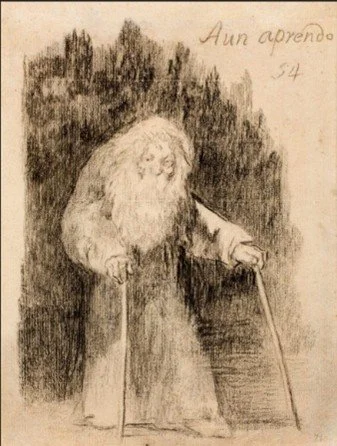
Aun Auprendo - "I Am Still Learning"
Francesco de Goya, Spanish Painter, 1746 - 1828
=====================
FOOTNOTES
(1) You could bypass the process altogether and simply stride to the left and vault the turnstiles. This happened once, when a person with something to say to Bill Ford decided that the best way to reach him would be to jump the barriers and head straight for the elevators. It's always amazing to me how many people decide to do something likely to change their life, generally not for the better, without a thought-through plan. This guy figured, all you had to do was run to the elevator, get on, and punch the highest number. After all, execs are always lurking on the top floor, aren't they? The problem is, the elevators went up to the eleventh floor. To get to the executive warrens on Twelve, you got off the elevator and faced another set of guards for clearance before taking the long slow spiral staircase to the top floor. All of this, of course, was academic, because the security guards way down at the entrance, who made a habit of not being asleep, had already contacted XO (our affectionate name for Executive Operations – they of the ex-Navy Seal and ex-FBI pedigree), who stopped the elevators on Nine and greeted our excited gentleman as the doors opened.
(2) Yes, there's yet another way, through the Executive Garage. Mere mortals rarely used this way. You drove up to the side of the building and presented your badge at a traffic gate. If you were one of the elite, you could enter. I used this a few times, so I think (memory fails me) that this was how you returned pool cars as well.
(3) The towers have changed hands over the years, and their future is uncertain.
(4) Now defunct, in some strange battle of new ownership that has locked it away from use for some time, as it hunches over the landscape from the Fairlane Mall, itself an imaginative rekindling of the "mall spirit," whose stores still manage, after all these years, to cling to existence.
(5) A nod to Shelley: https://www.poetryfoundation.org/poems/46565/ozymandias